

Close Range Taekwon-Do

Close Range Taekwon-Do Techniques

Whilst we commonly associate high kicking and ‘tournament sparring type’ movements with Taekwon-Do, most of these techniques are performed at long range (i.e. at full extension), it is vital that students and instructors do not overlook close range techniques.
Taekwon-Do, after all, was originally developed by General Choi Hong Hi, as a form of unarmed combat for the purpose of self-defense.
Self-defense situations, as we all know, are most likely to be at close range. That is, it is not always possible or practical to throw ‘flashy’ stereotyped Taekwon-Do kicks due to the close proximity of your attacker.
Many high ranking Taekwon-Do practitioners and successful tournament ‘fighters’ often come unstuck in ‘real’ situations because they cannot distinguish between modified tournament techniques and situations, and potentially devastating self defense movements to create maximum impact and immediate results.
The Human Body as a weapon
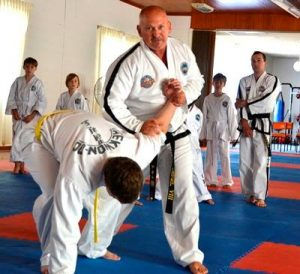
The body has a series of weapons, or attacking tools, which one can utilize for both attack and defense situations.
The appropriate selection of your weapon will be determined by a number of factors including, location of targets available, angle or direction of attack, and the distance of your assailant in relation to you.
Factors to be considered include:
Attacking tools available for your use
Targets available to attack
Distance from attacking tool to target
adelaide
Attacking Tools
Whilst we concentrate mainly on techniques which involve full range of our arms and legs, we can shorten them for close range self defense.

By using similar actions, we can adapt common techniques.
For example, front kick can be performed with the knee as the attacking tool, rather that the foot.
Front strike can be performed with the elbow, rather than the fist.
Other close range hand techniques include Upset punch (uppercut in boxing terms) to the body or chin, Palm heel strike to the chin or philtrum, Angle punch (or hook) to the body or face.

Your attacking tool needs to be carefully selected according to the required task.
For example, a poke in the eye with one or two fingers will do more damage than a forefist punch to the eye, due the greater amount of pressure concentrated to a small point of attack.
Attacking tools can include: forefist, back fist, side fist, knife hand, reverse knife hand, fingertip, ball of foot, heel, foot sword, instep, knee……etc.


留言